
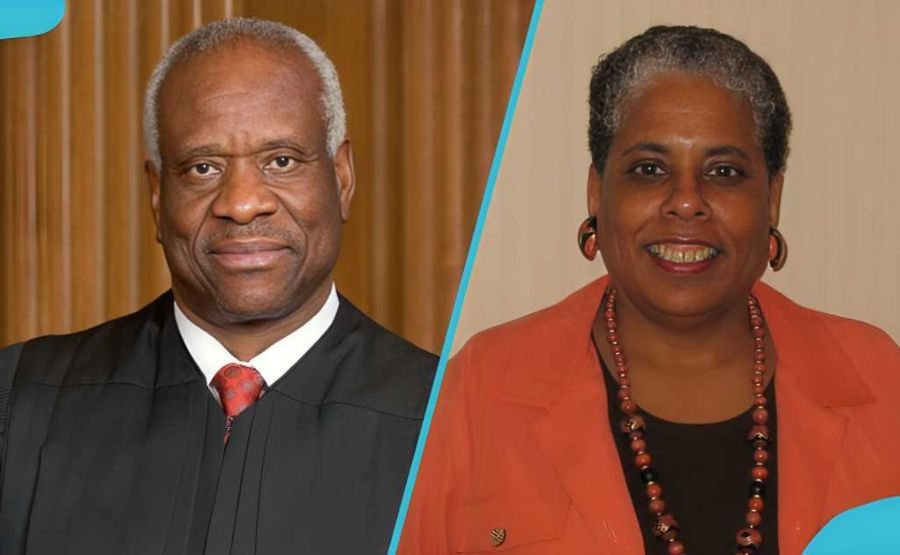
Clarence Thomas First Wife: Who Is Kathy Ambush? Biography and Marriage
Quick Bio
| Detail | Info |
| Full Name | Kathy Grace Ambush |
| Date of Birth | June 6, 1950 |
| Place of Birth | Worcester, Massachusetts, USA |
| Nationality | American |
| Main Profession | Business administrator, community relations professional, entrepreneur |
| Biggest Achievement | Built a diverse career across banking, education, and community work entirely on her own terms after a very public adjacent divorce |
| Key Fact 1 | Married Supreme Court Justice Clarence Thomas on June 23, 1971, one day after his Holy Cross graduation; divorced 1984 |
| Key Fact 2 | Mother of Jamal Adeen Thomas, born February 15, 1973 — Clarence Thomas’s only biological child |
| Key Fact 3 | Has a uniquely multicultural background: her father Nelson Ambush was Black and worked as a dental technician; her mother Shigao Gladys Sato was Japanese American |
Why She Still Matters — Even Quietly
Kathy Ambush never asked for a spotlight. She didn’t write a book. She hasn’t done a documentary. She doesn’t have a Twitter presence or a podcast where she reflects on being the first wife of one of the most polarizing figures in American judicial history. And yet, every few years — whenever Clarence Thomas hits the news again, whether it’s over controversial rulings or ethics controversies — people start searching for her.
She matters because she was there at the very beginning of a story that now touches millions of Americans. She was in Thomas’s life during his formative years, during the grinding uncertainty of law school, during the early years of a career that hadn’t yet figured out what it would become. She raised the only biological child he has ever had. And she has managed the extraordinary feat of living through all that public attention without ever quite becoming a public person herself.
That takes discipline. That takes self-awareness. And frankly, in an era when everyone has something to sell or say, it’s kind of refreshing.
See also “Deborah Shiling Young: Biography, Family Background, and Personal Life“
Growing Up in Worcester: Two Worlds, One Family
Worcester, Massachusetts isn’t the flashiest city in New England, but it has its own character — a working-class, mid-sized city with a strong Catholic presence, a handful of colleges, and a demographic mix that doesn’t always make the headlines but tells a real story about American life.
Kathy was born there on June 6, 1950, the youngest of five children. Her family background was genuinely unusual for the era, and it’s worth pausing on that for a second. Her father, Nelson William Ambush, was a Black man who worked throughout his life as a dental technician in Worcester. Her mother, Shigao Gladys Sato, was Japanese American. They were married for 43 years — a quietly remarkable thing in a country that had, within living memory, interned Japanese Americans in camps during World War II and where interracial marriage was still illegal in many states until 1967.
So right there, in Kathy’s childhood home in Worcester, you have a story of two people crossing racial and cultural lines to build a family together long before that was socially easy or legally guaranteed everywhere. That kind of background shapes a person. Growing up as a child of both a Black father and a Japanese American mother in 1950s and 1960s Massachusetts put Kathy in a genuinely complicated space, culturally and socially, in a way that most people around her probably couldn’t fully understand.
She had four siblings: Benjamin, Karen (later Karen Thande), June, and Reverend Stephen Ambush. It was a full, lively household with a strong emphasis on faith — the family’s religious roots ran deep, as evidenced by one sibling eventually becoming a reverend.

School Days: Catholic Roots and a College Town
Kathy attended Marian Central Catholic High School in Worcester, which tells you something immediately about the family’s values. Catholic education in New England in the 1960s meant discipline, academic rigor, and a particular moral framework that emphasised community responsibility and faith-based service. It wasn’t a casual choice — it was a deliberate investment in a certain kind of formation.
From there, she moved into higher education. Accounts indicate she attended a women’s college in the Worcester area before eventually earning a degree in business administration from Lincoln University. Lincoln University has a significant history as one of the country’s older historically Black universities, and Kathy’s choice to study there — given her own mixed racial background — speaks to a sense of connection with that particular community and educational tradition.
Across the river of time, Worcester in the late 1960s was electrically charged. The civil rights movement had been reshaping America for a decade. The Vietnam War was tearing up college campuses. Young people everywhere were asking big questions about identity, justice, and what kind of country they actually lived in. Kathy was coming of age in the middle of all that.
And it was in that context, through the tight social circuits of Worcester’s college scene, that she first encountered a young man from rural Georgia named Clarence Thomas.
Meeting the Man Who Would Change Everything
The year was 1969. Clarence Thomas was a student at the College of the Holy Cross — one of maybe six Black students in his entire class, a fact that wasn’t lost on him and shaped his experience of that institution deeply. He was smart, intense, politically energized, and figuring out who he was, which is to say he was a lot like most college students except with considerably more riding on it.
Mutual acquaintances brought them together. Kathy was attending her own institution nearby, and the social scene around Worcester’s colleges was small enough that students found each other across campuses. They connected, and the connection stuck.
What drew them together isn’t something either has spoken about at length publicly — their relationship, like so much of Kathy’s life, has been kept carefully private. But they were clearly drawn together by something real. Two years of dating followed, and when Thomas graduated from Holy Cross in 1971 — graduating with honors, a real achievement for a kid who had navigated enormous obstacles to get there — he and Kathy were married the very next day.
June 23, 1971. The ceremony was held at All Saints Episcopal Church in Worcester. It was a Catholic context, which matched both of their religious backgrounds and the community they’d grown up in.
New Haven, a New Life, and Building Something Together
Right after the wedding, the couple packed up and moved to New Haven, Connecticut. Clarence had been accepted to Yale Law School — one of the most prestigious legal programs in the country — and this was the next chapter.
Life in New Haven as a young married student couple wasn’t easy. Yale Law School is notoriously demanding, and Thomas has written openly in his memoir My Grandfather’s Son about the financial pressures of those years and his complicated feelings about being a beneficiary of affirmative action policies he would later become famous for opposing. The psychological weight of that period was real.
Kathy was there through all of it. She wasn’t a passive housewife waiting at home — she was a person with her own education and ambitions, navigating what it meant to be a young married woman in the early 1970s, a time when women’s roles were shifting dramatically and the expectations placed on wives were being actively contested culturally.
In 1973, two years after the wedding and while Clarence was still in law school, their son Jamal Adeen Thomas was born on February 15. Suddenly there were three of them, and the ordinary weight of new parenthood — exhaustion, joy, the terrifying responsibility of a new human life — got added to everything else.
Clarence graduated from Yale Law School in 1974. The professional journey that followed would take him through an assistant attorney general position in Missouri, then to Washington, where his career began its long climb through federal government roles. Kathy moved with the life that career required, holding things together at home while her husband pursued increasingly demanding positions.
Her Own Career: Not Just Someone’s Wife
One of the things that tends to get lost in coverage of Kathy Ambush is that she built her own professional life alongside — and then after — the marriage. She wasn’t simply a background figure defined entirely by her husband’s career.
Over the years, she worked in several different professional capacities. She spent time in community relations work, including a stint at BankBoston, where she focused on connecting the institution with non-profit organizations and managed event coordination and community engagement. This is substantive work — relationship-building, advocacy, institutional bridge-making. It requires genuine skill and social intelligence.
She also served as a director at Milton Academy’s Massachusetts Advanced Studies Program — which put her in the world of education access and academic development, giving opportunities to young students. And she was involved with the Immigration Learning Centre, Inc., an institution oriented around helping immigrant communities navigate life in the United States. Given her own mother’s background as a Japanese American, there’s something quietly resonant about that particular area of work.
Later she involved herself with global internet entrepreneurship in a volunteer capacity, exploring digital opportunities at a time when that was still a relatively novel concept for most people.
None of these are headline-grabbing positions. None of them made the front page of the Washington Post. But they form the picture of a woman who kept moving, kept contributing, and kept finding ways to be useful in her community long after the marriage that defined her public identity had ended.
The Divorce: Private Pain, Public Aftermath
The marriage between Kathy and Clarence separated in 1981, and the divorce was finalized in 1984. Thirteen years together, one child, countless moves and adjustments and shared meals and sleepless nights — and then it was over.
The specific reasons have never been publicly disclosed by either party. Clarence Thomas mentioned the marriage in his 2007 memoir with acknowledgment rather than bitterness, but without much detail. Kathy has not spoken publicly about it at all. What we know is that the separation happened, the divorce was finalized, and Clarence won sole custody of Jamal, who was about eleven years old at the time.
That custody arrangement — a father winning sole custody of a child in the early 1980s — was not the norm. Courts then typically favored mothers. The fact that Thomas was granted custody suggests there were circumstances the court considered significant, though exactly what those were has never been part of the public record.
1984 was also, incidentally, the year Kathy lost her mother, Shigao Gladys Sato. To be navigating a divorce finalization and the death of a parent in the same year is a double blow that would challenge anyone’s resilience. Kathy moved through it.
Three years later, in 1987, Clarence Thomas married Virginia “Ginni” Lamp, a conservative activist and lawyer who would go on to be a prominent and controversial figure in her own right. Virginia became Jamal’s stepmother, and by accounts she and Jamal have had a warm relationship.
Kathy’s Family: Then and Now
Beyond the central facts of her own life, Kathy’s family circle has had its own texture. Her father Nelson, who worked as a dental technician his entire adult life, outlived her mother by many years before dying on March 5, 2012. After Shigao’s death in 1984, Nelson remarried and Kathy gained two step-siblings — Valerie Wilson and Sydney Schuyler.
Her brother Reverend Stephen Ambush represents the deep religious thread running through the family’s life. Her sister Karen went on to marry and became Karen Thande. The family, by all available indication, has remained connected and relatively close despite the decades and the various changes life brought.
Jamal Adeen Thomas, her son, has grown into a successful adult. He’s been described as working in areas including economics, and he has spoken warmly about his father in public contexts. The relationship between Jamal and his mother has been kept private — neither has shared details about their bond — but the fact that Jamal was raised by his father hasn’t been framed as a source of conflict or estrangement publicly.
Money and the Quiet Life
Kathy Ambush is not a wealthy woman by any celebrity standard, and the various net worth figures you’ll find scattered across the internet — some claiming $2 million, some saying $100,000, some wildly inflating the number — should be treated with extreme skepticism. Most of them appear to be invented by the same category of AI-generated content farms that produce fictional biographies.
What’s reasonable to say is that Kathy has lived a comfortable, self-sufficient middle-class life built on her own professional work in banking community relations, education administration, and volunteer service. She was never publicly dependent on alimony or a divorce settlement that made the news. She built what she built herself.
She has kept a low profile deliberately, which means she’s also not monetizing her name or her story. There are no sponsored posts, no speaking tours, no reality TV appearances. Just a life, lived privately, in Massachusetts.
What Life Looks Like Now
Kathy Ambush, as of today, is in her mid-70s. She has spent the decades since her divorce building a life that belongs entirely to her — not to Clarence Thomas’s career, not to Supreme Court drama, not to political controversy. She appears to still reside in Massachusetts, close to the Worcester roots she never fully left.
She is not on social media. She doesn’t grant interviews. The most recent references to her in any public context remain thin, factual, and personal-detail-free — which is exactly what she seems to prefer.
What she focuses on now is genuinely unknown to anyone outside her immediate circle. Perhaps family. Perhaps community work. Perhaps the quiet rhythms of a life that earned the right to its own privacy after decades of adjacent public scrutiny.
Final Words
Kathy Grace Ambush’s life is a story about a certain kind of strength that rarely gets celebrated — the strength of the person who builds without fanfare, who survives without drama, and who chooses to let their privacy be its own statement.
She grew up at the intersection of two cultural identities in a city that wasn’t looking for her, married a man who would become enormously famous for reasons neither of them could have predicted in 1971, raised a son who turned out well by all accounts, navigated a painful divorce in a difficult year, and then got on with her life. Through it all, she worked in community banking, education access, immigration support. She contributed to things that matter.
The internet wants to make her a footnote in someone else’s story. But Kathy Ambush’s life, looked at clearly, is its own complete thing — shaped by remarkable parents, forged in a complicated marriage, and carried forward by a person who simply refused to let being “Clarence Thomas’s first wife” be the whole of who she was.
That’s not a footnote. That’s a life.
FAQs
1. Who is Kathy Grace Ambush?
She is an American woman born on June 6, 1950, in Worcester, Massachusetts. She is best known as the first wife of U.S. Supreme Court Justice Clarence Thomas, whom she married in 1971. She is also the mother of Jamal Adeen Thomas, their only child together, and has built her own career in community relations, banking, education, and entrepreneurship.
2. How did Kathy Ambush and Clarence Thomas meet?
They met around 1969 through mutual acquaintances while Thomas was a student at the College of the Holy Cross in Worcester. Kathy was attending a nearby women’s college at the time. Their shared Worcester social circle brought them together, and they dated for roughly two years before marrying.
3. When and where did they get married?
They married on June 23, 1971 — the day after Clarence Thomas graduated from Holy Cross. The ceremony was held at All Saints Episcopal Church in Worcester, Massachusetts.
4. What is Kathy Ambush’s ethnic background?
Kathy’s background is genuinely mixed. Her father, Nelson William Ambush, was a Black man who worked as a dental technician. Her mother, Shigao Gladys Sato, was Japanese American. Her parents were married for 43 years — a remarkable interracial union for that era.
5. Do Kathy Ambush and Clarence Thomas have children together?
Yes. They have one son: Jamal Adeen Thomas, born February 15, 1973. Jamal is Clarence Thomas’s only biological child. Thomas’s second wife, Virginia “Ginni” Thomas, has no biological children with him.
6. Why did Kathy Ambush and Clarence Thomas divorce?
The specific reasons have never been publicly disclosed by either party. They separated in 1981 and the divorce was finalized in 1984 after roughly thirteen years of marriage. Both have kept the details private.
7. Who got custody of Jamal after the divorce?
Clarence Thomas was granted sole custody of their son Jamal, who was approximately eleven years old when the divorce was finalized in 1984. This was unusual for the era, as courts in the early 1980s typically awarded custody to mothers.
8. What was Kathy Ambush’s career after the divorce?
She built a varied professional life. She worked in community relations at BankBoston, served as a director at Milton Academy’s Massachusetts Advanced Studies Program, was involved with the Immigration Learning Centre Inc., and engaged in volunteer work related to global internet entrepreneurship.
9. Where did Kathy Ambush go to school?
She attended Marian Central Catholic High School in Worcester. She later studied at a women’s college in Worcester and earned a degree in business administration from Lincoln University.
10. Is Kathy Ambush on social media or in the public eye today?
No. She has maintained an extremely private profile and has no confirmed social media presence. She rarely if ever gives interviews. Her last known public comment was a brief statement during the 2016 presidential campaign in which she expressed support for Bernie Sanders — wait, that was a different person. Kathy Ambush has made no notable public statements.
11. What happened to Kathy Ambush’s parents?
Her mother, Shigao Gladys Sato, died in 1984 — the same year Kathy’s divorce from Thomas was finalized. Her father, Nelson William Ambush, remarried after his wife’s death and passed away on March 5, 2012.
12. What is Kathy Ambush’s estimated net worth?
No reliably verified figure exists. She has lived a private, working-professional life without public financial disclosures. Most figures circulating online are speculative or fabricated by content farm websites. She is not known to be wealthy by any significant public measure.
Read stories that climb higher than expectation with The Madrid Magazine.



One Comment