Karen Finerman Ex Husband: The Truth About Her Marriage to Lawrence Golub
Quick Bio
| Detail | Info |
| Full Name | Lawrence E. Golub |
| Date of Birth | October 3, 1959 |
| Nationality | American |
| Main Profession | Founder & CEO, Golub Capital |
| Biggest Achievements | Built Golub Capital from a $20M startup into a $65B+ credit empire; White House Fellow (1992–93); Baker Scholar at Harvard Business School; Harvard Law Review editor |
| Key Facts | Married to CNBC’s Karen Finerman (his wife, not ex-wife); father of two sets of twins; grandchildren of poor immigrant families who became one of New York finance’s most powerful couples |
Quick note: Several online searches tag Lawrence Golub as Karen Finerman’s “ex-husband,” but that’s simply wrong. He and Karen are married and have been for decades, raising four children together in New York City. The biography below tells Lawrence’s story as it actually is.
Why This Guy Still Matters
Here’s the thing about Lawrence Golub — he doesn’t show up on the cover of magazines. He doesn’t go on podcasts to talk about his feelings about the market. He doesn’t have a signature catchphrase or a reality TV cameo. And yet, if you work in private credit or middle-market lending in the United States, his name is everywhere.
Golub Capital, the firm he founded in 1994 with literally just himself and one assistant, now manages over $65 billion in capital. That’s not a typo. Sixty-five billion. He’s built one of the most consistently respected direct lending operations in the country, winning industry awards year after year — Lender of the Year, Senior Lender of the Year, you name it. He’s done it not by being flashy, but by being relentlessly good at a relatively unsexy corner of finance: lending money to mid-sized companies that the big Wall Street banks often overlook.
On top of that, he’s been a genuine force in public service, philanthropy, and education. For people who follow finance closely, Lawrence Golub represents something increasingly rare — someone who built an enormous, durable institution quietly and with integrity, while also giving back in substantive ways.
See also “Rebeccah Heinrichs Biography: Career, Education, Family, and National Security Expertise“
Growing Up in New York, the Son of Immigrants
Lawrence was born on October 3, 1959, in New York City. Both sides of his family came from immigrant backgrounds — his parents grew up in what he’s described as modest circumstances, the children of people who arrived in America with not much more than determination. That origin story matters a lot to understanding Lawrence, because by every account, it shaped how he thinks about hard work, opportunity, and what success is actually for.
Growing up in the suburbs of New York, he was, by his own description, a painfully shy kid. Not the loud, gregarious type that you might expect from someone who’d eventually run a multi-billion-dollar firm and rub shoulders with the most powerful financiers in the world. But shyness, as it turns out, isn’t the same as being incurious or unambitious. Lawrence was clearly paying attention to the world around him, thinking carefully about what he wanted to do with his life, and putting in serious work at school.
That work paid off in a big way. He got into Harvard College, where he graduated magna cum laude in economics. That kind of distinction at Harvard doesn’t happen by accident — it takes real intellectual horsepower and serious discipline. But Lawrence wasn’t done yet. He went on to pursue both a law degree and an MBA simultaneously through Harvard’s joint JD-MBA program, a notoriously demanding track that only a small number of people attempt each year. At Harvard Business School, he was named a Baker Scholar — which is the school’s way of recognizing the top graduates of their class. At Harvard Law School, he served as an editor of the Harvard Law Review, one of the most prestigious student journals in American legal academia.
So to put it plainly: by the time Lawrence Golub walked out of Harvard, he had three degrees from one of the world’s most demanding universities, honors in all of them, and a head full of ideas about how money, law, and business all fit together.
The Early Career: Learning the Game
Right out of school, Lawrence landed at Allen & Company, the well-known investment bank and media advisory firm based in New York. It’s the kind of place where you do a bit of everything — private equity deals, corporate finance, mergers and acquisitions. For a young guy trying to figure out where he fit in the financial world, it was a genuinely solid training ground.
From there, he moved to Wasserstein Perella, one of the legendary boutique investment banks of the 1980s and early 90s. This was the era of massive leveraged buyouts, corporate raiders, and jaw-dropping deal flow on Wall Street. Lawrence rose to Managing Director there, establishing the firm’s capital markets group and heading up its debt restructuring practice. He later described joining Wasserstein Perella the very week that Drexel Burnham Lambert — the junk bond giant — filed for bankruptcy. That timing was either terrible luck or a masterclass in walking into chaos and figuring it out, and Lawrence apparently opted for the latter.
After Wasserstein Perella, he joined Bankers Trust Company as a Managing Director, applying his skills to their Risk Merchant Bank division, where he used derivative products in principal investing and M&A transactions. By this point in his career, Lawrence had touched nearly every corner of high-stakes finance — he’d done deals, restructured debt, navigated a bankruptcy wave, and developed a deep understanding of how credit markets actually function under pressure.
What he still hadn’t done, though, was build something entirely his own.
The White House, Then the Big Leap
In 1992, something pretty unusual happened in Lawrence’s life. He was selected as a White House Fellow — one of just fifteen people chosen nationally from nearly 700 applicants that year. The White House Fellows program is one of the most competitive public service fellowships in the country, bringing together leaders from different fields to work directly for senior government officials and cabinet members for a year. It’s the kind of thing that broadens your perspective in ways that pure finance never could.
Lawrence served his year, got a close-up look at how government and policy actually work, and then — crucially — he took everything he’d learned in banking, law, and public service and made the decision to go out by himself.
In 1994, Lawrence Golub founded Golub Capital. He started with a $20 million fund. His “team” was him and one assistant. The whole operation fit in a small office. It was either an act of tremendous confidence or a very well-calculated bet, and given everything that followed, probably both.
The early investors were, as Lawrence has described them, business legends — people whose belief in him was both inspiring and genuinely intimidating. The first fund did well. Word spread. More capital came in. By 2000, the firm had grown to around eight or ten people and was managing a couple of hundred million dollars. Not enormous by Wall Street standards, but real, solid, and growing.
Building the Golub Capital Empire
The dot-com crash of the early 2000s was actually a turning point for Golub Capital — not as a setback, but as an opportunity. While other firms were getting burned by tech investments and equity market volatility, Golub Capital was focused on middle-market lending, providing debt capital to mid-sized companies that were largely insulated from the internet bubble chaos. The strategy worked. The firm kept growing.
Then in 2003, Lawrence’s brother David Golub joined as President, and the two of them formed one of finance’s more durable sibling partnerships. Having David in the room meant Lawrence could focus on vision and strategy while the firm’s day-to-day operations were in the hands of someone he trusted completely.
The milestones started stacking up. By 2005, after the closing of their fourth fund, Golub Capital had raised $800 million in equity capital in that single vehicle. Their fifth fund raised $700 million. By 2014, total capital under management hit $10 billion. And from there, the growth didn’t slow down — it accelerated. By 2024, the firm was managing over $65 billion in capital across its various strategies, making Golub Capital one of the largest and most decorated direct lending platforms in the country.
Year after year, the firm has been ranked among the top three middle-market lenders in the U.S. for senior secured loans tied to leveraged buyouts. They have received numerous awards for Lender of the Year from Private Debt Investors. Mergers & Acquisitions named them their Mid-Market Lender of the Year. These aren’t participation trophies — in the competitive, results-obsessed world of institutional lending, you earn that kind of recognition by consistently delivering for your borrowers and your investors.
Love, Twins, and Life with Karen Finerman
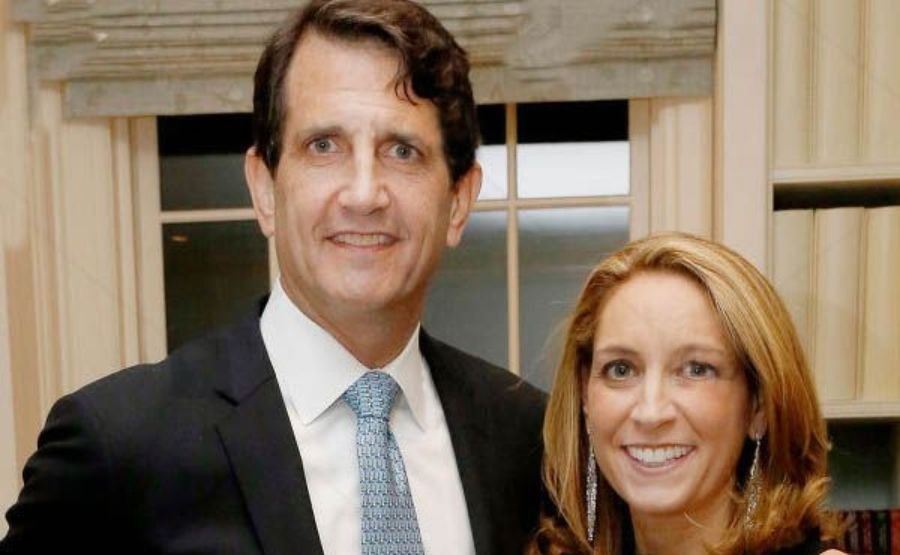
So here’s where the personal story gets interesting. Lawrence Golub, the quietly brilliant Harvard triple-degree guy building his lending empire in New York, met Karen Finerman on a blind date. The setup was organized by one of Lawrence’s friends from Harvard Law School — someone who apparently had excellent matchmaking instincts, because it clearly worked.
Karen, who was busy co-founding her own hedge fund (Metropolitan Capital Advisors) and would go on to become one of the most recognizable faces in financial television as a permanent panelist on CNBC’s Fast Money, was by all accounts Lawrence’s equal in every sense. Two serious New York finance people, both running their own firms, both driven, both smart as anything — sitting down for what must have been a pretty intense first date.
They married and proceeded to have not one but two sets of twins. Four kids total — Lucy, Jack, William, and Kate. Raising two sets of twins while both parents are running their own financial firms in New York City is the kind of logistical challenge that would make most people’s heads spin, but by every account they made it work. Karen has spoken publicly about working full-time while raising her kids, managing the chaos through sheer organization and, presumably, genuine partnership with Lawrence.
Their kids have grown up to be impressive in their own right. One attended Harvard, another Stanford — which gives you a sense of the household they grew up in.
Lawrence and Karen have also been deeply connected through shared philanthropy, most notably their support for Parkinson’s disease research. Lawrence has funded the Golub Stem Cell Initiative for Parkinson’s at the New York Stem Cell Foundation and backed research at the Harvard Stem Cell Institute. Both he and Karen have served on the board of the Michael J. Fox Foundation for Parkinson’s Research.
The Civic Side: More Than Just Business
Something that sets Lawrence Golub apart from a lot of people at his financial level is the sheer range and seriousness of his public and civic commitments. This isn’t performative philanthropy — he’s spent years actually doing the work.
He served for over twelve years as one of three private members of the Financial Control Board of the State of New York — a real oversight body with real teeth. He was Treasurer of the White House Fellows Foundation for fifteen years. He chaired the Mosholu Preservation Corporation, a nonprofit that develops and manages low-income housing in the Bronx. He’s served on the board of Horace Mann School, the Harvard Medical School Board of Fellows, the Columbia Medical School Board of Advisors, the Advisory Council of Harvard Kennedy School’s Mossavar-Rahmani Center, and the Stanford Interdisciplinary Life Sciences Council.
That’s not a man who puts his name on things for prestige. That’s a man who actually shows up.
He also founded the Harvard University JD-MBA Alumni Association — because of course he did. When you’ve done the JD-MBA program, graduated at the top of both schools, and then built a massive financial firm, you probably feel some obligation to the path that made it possible.
The Money Side
So what’s all this worth? Lawrence Golub’s net worth is estimated at around $500 million, though given his ownership stake in Golub Capital — which manages more than $65 billion in capital and is publicly traded through its business development company, Golub Capital BDC — the actual figure is likely higher and subject to market fluctuations.
He’s not the kind of person who splashes his wealth around. You won’t see his name on a yacht registry or hear about a private island purchase. He and Karen live in a well-appointed apartment on the Upper East Side of Manhattan, which, while certainly not cheap, is also deeply in keeping with their image as serious New York professionals rather than showy financial celebrities.
Karen’s net worth is separately estimated in the range of $100 million or more, built through her decades of running Metropolitan Capital Advisors. Together, they represent one of the more low-key but genuinely wealthy couples in the New York financial world.
Where Things Stand Today
As of 2026, Lawrence Golub is 66 years old and very much in the game. He remains CEO of Golub Capital, which crossed $65 billion in capital under management and continues to expand its direct lending, middle market, and credit strategies. His brother David serves as CEO of Golub Capital BDC, the publicly traded piece of the business, while Lawrence focuses on the broader firm.
He continues his extensive board and advisory roles. His children are grown — Lucy graduated from Harvard, Jack from Stanford, and William and Kate are making their own ways in the world. He and Karen are still very much together, still based in New York, and still showing up for the boards and foundations they care about.
There’s something quietly satisfying about a story like this one. A shy kid from New York, the grandchild of immigrants, who worked hard enough to get into Harvard three times over, then built one of the most respected lending firms in American finance from essentially nothing. Not by being the loudest person in the room. Not by chasing the spotlight. But by being consistently excellent, consistently reliable, and consistently present — in business, in civic life, and in his family.
Final Words
Lawrence Golub isn’t the kind of figure who gets made into a documentary or profiled in flashy magazines. He doesn’t court that kind of attention, and honestly, he doesn’t need it. What he’s built — Golub Capital — speaks with more authority than any press release ever could. From a $20 million first fund to $65 billion in capital under management, from a shy kid in the New York suburbs to a White House Fellow, a Harvard triple-honor graduate, and one of the most awarded lenders in American finance, his trajectory is the kind that rewards patience over showmanship.
What makes him different isn’t just the résumé — it’s the consistency. He’s been the same person at every stage: disciplined, principled, genuinely engaged with the world beyond finance, and deeply loyal to the institutions and causes he cares about. In an industry that has no shortage of people who are famous for being famous, Lawrence Golub is famous for being good. That’s rarer than it sounds.
FAQs
1. Is Lawrence Golub really Karen Finerman’s ex-husband?
No. This is a common misconception floating around online. Lawrence Golub is Karen Finerman’s current husband. They have been married for decades and have four children together — two sets of twins.
2. When and where was Lawrence Golub born?
He was born on October 3, 1959, in New York City. He grew up in the New York suburbs.
3. What does Golub Capital actually do?
Golub Capital is a direct lender — meaning the firm lends money directly to mid-sized companies, mostly in the context of leveraged buyouts and private equity-backed deals. It’s a form of private credit, sitting between traditional bank loans and public bond markets.
4. How big is Golub Capital today?
As of early 2024, Golub Capital manages over $65 billion in capital. That figure includes leverage, which is standard for measuring assets under management in credit-focused firms.
5. How did Lawrence Golub start Golub Capital?
He launched the firm in 1994 with a $20 million fund and one assistant. Before that, he’d spent a decade working at Allen & Company, Wasserstein Perella, and Bankers Trust.
6. What is a White House Fellow and why does it matter for Lawrence?
The White House Fellows program selects roughly 15 outstanding young professionals each year to serve as special assistants in the executive branch of the U.S. government. Lawrence was selected for the 1992–93 class, beating out hundreds of applicants. It’s a prestigious recognition of leadership potential, not just professional achievement.
7. What degrees does Lawrence Golub have?
He has an undergraduate degree in economics from Harvard College (magna cum laude), an MBA from Harvard Business School (Baker Scholar), and a JD from Harvard Law School (editor of the Harvard Law Review). All three from Harvard.
8. How did Lawrence Golub and Karen Finerman meet?
They met on a blind date arranged by one of Lawrence’s friends from Harvard Law School. It clearly worked out.
9. What does Lawrence Golub do outside of finance?
Quite a lot. He’s been involved with the Financial Control Board of New York, the White House Fellows Foundation, the Michael J. Fox Foundation for Parkinson’s Research, Harvard Medical School, Columbia Medical School, Stanford’s Life Sciences Council, low-income housing work in the Bronx through the Mosholu Preservation Corporation, and more.
10. How much is Lawrence Golub worth?
Estimates put his net worth at around $500 million, though his stake in Golub Capital likely makes the real figure higher and harder to pin down precisely.
11. Does Lawrence Golub have a public profile like his wife Karen?
Not really. Karen is one of CNBC’s most recognizable financial commentators. Lawrence operates much more quietly — he rarely does media appearances and focuses on running Golub Capital and his various civic roles.
12. What makes Golub Capital different from other private credit firms?
Consistency and specialization. The firm has focused on middle-market lending for over 30 years without dramatically pivoting its strategy every time a new trend comes along. That steadiness has earned it a reputation for reliability among both borrowers and investors — which, in credit markets, is worth more than almost anything else.
Read stories that climb higher than expectation with The Madrid Magazine.




One Comment